Māori Health and Wellbeing: Traditional Approaches

kwmedley.com – Māori health and wellbeing encompass more than just physical health; they are deeply rooted in the interconnectedness of body, mind, and spirit, as well as the individual’s relationship with family, community, and the environment. Traditional Māori health practices have long been based on holistic principles, integrating spiritual, physical, and environmental elements to maintain balance and wellbeing. However, modern challenges such as the impact of colonization, social inequities, and the pressures of contemporary life have created significant barriers to achieving optimal health for Māori communities. This article explores both the traditional Māori approaches to health and wellbeing, as well as the challenges faced in maintaining these practices in the modern world.

Traditional Māori Approaches to Health

Traditional Māori health practices, known as hauora, are grounded in a holistic worldview that sees health as the balance between spiritual, physical, mental, and social aspects of life. Māori health is deeply connected to the concept of whānau (family) and wairua (spirit), with the understanding that a person’s wellbeing is affected by their relationships with their ancestors, their environment, and the community.

The Four Dimensions of Māori Health

The traditional Māori framework for health is often represented through the four dimensions of hauora: taha tinana (physical health), taha wairua (spiritual health), taha hinengaro (mental health), and taha whānau (family and social health). Each dimension is seen as interconnected, and balance between them is considered essential for overall wellbeing.

  • Taha Tinana (Physical Health): This refers to the physical well-being of the individual, including the proper functioning of the body, nutrition, exercise, and rest. In traditional Māori society, maintaining physical health was tied to living in harmony with the natural environment, such as through hunting, fishing, and the cultivation of food.
  • Taha Wairua (Spiritual Health): Spiritual health is viewed as foundational to overall wellbeing. Māori people believe that a strong connection to the spiritual realm, ancestors, and the natural world helps to sustain a sense of purpose, balance, and harmony. Spiritual practices, such as prayer (karakia) and rituals, play a key role in maintaining spiritual health.
  • Taha Hinengaro (Mental Health): Mental wellbeing is seen as an integral part of the individual’s ability to cope with life’s challenges, manage emotions, and maintain clear thought. The Māori view on mental health emphasizes the importance of community support, reflection, and the sharing of experiences to foster resilience.
  • Taha Whānau (Family and Social Health): Family and community are central to Māori health. Whānau, extended family, and the broader community provide the emotional and practical support needed for maintaining balance and wellbeing. Social relationships are seen as vital to individual health, and the collective responsibility of the community to care for its members is a key value.

Traditional Healing Practices

Māori healing practices are centered around the belief that illness results from imbalances in the body, mind, or spirit. Traditional Māori healers, known as rongoā practitioners or tohunga rongoā, use a variety of methods to restore balance, including herbal remedies, physical therapies, and spiritual healing.

  • Rongoā Māori (Traditional Medicine): Rongoā Māori involves the use of native plants, such as kawakawa, mānuka, and harakeke (flax), to treat ailments. These plants have been used for centuries to treat both physical and mental health conditions. Traditional healers also used massage techniques, such as mirimiri, to release tension and restore energy to the body.
  • Spiritual Healing: Spiritual health is often addressed through rituals and ceremonies aimed at restoring harmony between individuals, their ancestors, and the environment. Karakia (prayers or chants) and whakawātea (rituals for releasing negative energy) are used to help heal spiritual and emotional wounds.
  • Whenua and Wairua (Connection to Land and Spirit): Traditional Māori belief holds that health is deeply connected to the land. A person’s well-being is affected by their relationship to the whenua (land) and their wairua (spirit). The practice of marae and the importance of gathering on the land for ceremonies are ways of maintaining balance and connection to ancestral roots.

Modern Challenges to Māori Health

While traditional Māori health practices remain relevant and are increasingly recognized in contemporary healthcare systems, Māori communities face significant health challenges in the modern world. These challenges are shaped by historical, social, and economic factors, many of which have roots in colonization.

Impact of Colonization

The arrival of European settlers in New Zealand (Aotearoa) brought significant disruptions to Māori ways of life. Colonization led to the displacement of Māori communities, the loss of land, and the imposition of foreign systems of governance and healthcare. This resulted in the erosion of traditional Māori knowledge, including health practices, and led to significant disparities in health outcomes between Māori and non-Māori populations.

The introduction of European diseases, as well as the breakdown of Māori social structures, also contributed to a decline in Māori health. Many Māori were displaced from their ancestral lands, which disrupted their connection to the environment, a vital component of their traditional health practices.

Social and Economic Inequalities

Māori health is also affected by social and economic inequalities. High levels of poverty, lower access to quality healthcare, and disparities in education have contributed to poorer health outcomes for Māori. Issues such as housing insecurity, food insecurity, and limited access to healthcare services remain significant barriers to achieving health equity.

Furthermore, the impact of systemic racism within the healthcare system has created a mistrust of Western medical practices. Many Māori feel that the mainstream healthcare system does not adequately cater to their cultural needs, resulting in lower rates of engagement with healthcare providers and poorer health outcomes.

Rising Chronic Diseases and Mental Health Issues

Māori communities are disproportionately affected by chronic diseases, such as diabetes, cardiovascular disease, and obesity, which are linked to lifestyle factors such as poor diet, lack of physical activity, and smoking. These diseases have become significant challenges to Māori health, with the health system struggling to provide culturally relevant care.

Mental health issues are also rising among Māori, particularly among youth. The pressures of modern life, combined with the challenges of cultural identity, systemic racism, and social inequality, have contributed to an increase in mental health concerns. Suicide rates among Māori youth are higher than the national average, highlighting the urgent need for culturally appropriate mental health services and support systems.

Integrating Traditional and Modern Approaches

The integration of traditional Māori health practices with modern healthcare approaches is seen as a potential solution to address these challenges. Many Māori health advocates call for a healthcare system that recognizes and incorporates Māori cultural values, practices, and perspectives.

The Role of Whānau in Modern Health

One key way to address health disparities is to focus on the role of whānau (family) in health and wellbeing. Whānau-based health initiatives aim to involve families in the healing process, fostering support networks and providing culturally relevant care. These initiatives often incorporate traditional healing methods alongside modern medical treatments, creating a holistic approach to health.

Te Ao Māori and Modern Health Education

Health education that embraces te ao Māori (the Māori worldview) is another essential part of improving Māori health. This includes promoting the four dimensions of hauora—taha tinana, taha wairua, taha hinengaro, and taha whānau—in schools, community groups, and healthcare settings. This approach encourages a more inclusive understanding of health that values Māori cultural practices while also addressing the needs of modern healthcare.

Māori Leadership in Health

Increasing Māori leadership in the health sector is essential for improving health outcomes for Māori. Māori health providers, iwi (tribal) health organizations, and Māori doctors and nurses are integral in advocating for culturally competent care. These leaders can bridge the gap between traditional Māori practices and contemporary healthcare, ensuring that Māori communities receive the support and care they need.

Conclusion

Māori health and wellbeing are deeply rooted in a holistic worldview that emphasizes the interconnectedness of physical, mental, spiritual, and social health. While traditional Māori health practices continue to offer valuable insights into holistic healing, modern challenges such as the legacy of colonization, social inequities, and rising chronic diseases pose significant barriers to achieving optimal health. However, the integration of traditional and modern health approaches, along with a renewed focus on Māori leadership and cultural competency in healthcare, offers hope for improving health outcomes for Māori communities. By honoring Māori knowledge and values, New Zealand can move toward a more inclusive and equitable healthcare system that supports the wellbeing of all its people.
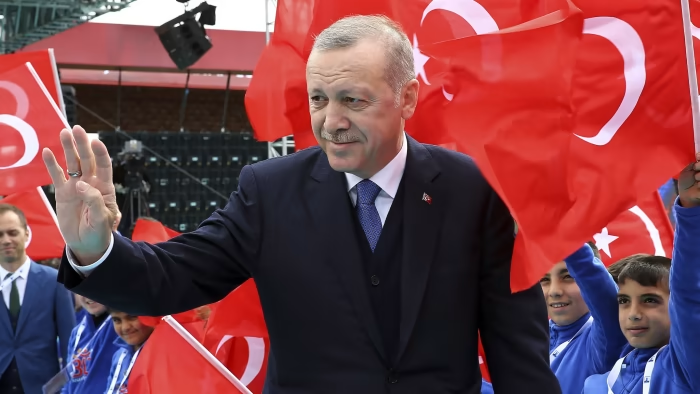
Recep Tayyip Erdoğan: A Modern Turkish Politics

kwmedley.com – Recep Tayyip Erdoğan, a towering figure in contemporary Turkish politics, served as the Prime Minister of Turkey from 2003 to 2014 and has been the President of Turkey since 2014. His tenure as Prime Minister marked a pivotal period of transformation for Turkey, during which the country experienced significant economic growth, political shifts, and infrastructure developments. Erdoğan’s rise from a charismatic leader in local politics to a dominant figure on the national and international stage reflects his ability to consolidate power and reshape Turkey’s political landscape.

As Prime Minister, Erdoğan was instrumental in implementing economic reforms, modernizing the country’s infrastructure, and steering Turkey towards greater international influence. However, his tenure was also marked by increasing polarization, authoritarian trends, and criticism regarding the erosion of democratic principles. This article explores Erdoğan’s time as Prime Minister and his impact on modern Turkish politics, which continues to shape the country today.

Early Life and Political Rise

Recep Tayyip Erdoğan was born on February 26, 1954, in Istanbul, Turkey. Raised in a working-class neighborhood, he experienced modest beginnings, which shaped his political and leadership style. Erdoğan attended Imam Hatip schools, which catered to religious students, and later studied at the Mimar Sinan University Faculty of Arts, where he earned a degree in economics.

Erdoğan’s political career began in the 1970s when he became involved in the political and religious youth movements in Istanbul. His leadership qualities were soon recognized, and he joined the National Salvation Party, which had Islamist roots. By the 1990s, Erdoğan’s political influence had grown, and he was elected mayor of Istanbul in 1994, where he gained a reputation for pragmatic governance, overseeing major infrastructure projects and improvements in the city’s public services.

In 2001, Erdoğan co-founded the Justice and Development Party (AKP) alongside other figures from the Islamic political spectrum. The AKP quickly became a dominant force in Turkish politics, capturing significant support among conservative voters, secular liberals, and economic reformists. Erdoğan’s rise to the role of Prime Minister in 2003 marked the beginning of a new political era for Turkey.

Prime Minister of Turkey (2003–2014)

Recep Tayyip Erdoğan became Prime Minister of Turkey after his party, the AKP, won the 2002 parliamentary elections in a landslide. He served as Prime Minister from 2003 to 2014, a period that saw profound changes in the country’s economic, political, and social structures. Erdoğan’s leadership style emphasized pragmatism, economic modernization, and assertive foreign policy, all while maintaining a strong connection with Turkey’s conservative and religious segments.

Economic Transformation and Growth

Erdoğan’s tenure as Prime Minister was marked by significant economic reforms that transformed Turkey into one of the fastest-growing economies in the world. His government focused on stabilizing Turkey’s financial system, reducing inflation, and boosting foreign investment. Key economic policies included:

  1. Privatization of State-Owned Enterprises: Erdoğan’s government privatized several major state-owned companies and industries, which helped reduce Turkey’s reliance on government-controlled sectors and encouraged foreign investment.
  2. Infrastructure and Urban Development: Erdoğan oversaw major infrastructure projects, including new highways, bridges, and airports, as well as the development of Istanbul’s urban landscape. These projects not only modernized Turkey’s infrastructure but also boosted the economy by creating jobs and attracting investment.
  3. Economic Growth and Global Integration: Under Erdoğan’s leadership, Turkey’s GDP grew rapidly, and the country became an important player in global trade. Erdoğan’s government focused on deepening Turkey’s integration with international markets, while also focusing on the domestic economy.
  4. Reduction of Public Debt and Inflation: The government succeeded in curbing inflation and significantly reducing public debt, which had been major concerns for Turkey in the previous decade.

This period of economic growth allowed Erdoğan to build political support, particularly among middle-class and conservative voters who benefited from the prosperity that accompanied these reforms.

Consolidation of Political Power

During Erdoğan’s time as Prime Minister, he focused on consolidating his political power, which led to the strengthening of the executive branch and the marginalization of the military’s influence in politics. His government passed a series of legal and constitutional reforms that aimed to strengthen democratic institutions while reducing the political power of the military and judiciary.

One of the most significant steps Erdoğan took in consolidating his power was the reform of the Turkish military’s position in political life. Historically, the military had played a central role in Turkish politics, often intervening in civilian affairs. However, Erdoğan’s government worked to weaken the military’s grip on power, making reforms to curb its influence over the judiciary and political system. These efforts were seen as crucial in ensuring Turkey’s political stability and advancing its democratic process.

Foreign Policy and Regional Influence

Erdoğan’s foreign policy during his tenure as Prime Minister was centered on expanding Turkey’s influence in the Middle East and the broader international arena. He pursued a foreign policy strategy aimed at positioning Turkey as a regional leader and a bridge between Europe and the Middle East.

  1. European Union Accession Talks: Erdoğan’s government continued negotiations for Turkey’s EU accession, although these talks faced numerous hurdles, particularly over issues such as human rights, democracy, and freedom of speech. Despite these challenges, Erdoğan remained a proponent of Turkey’s European integration, viewing it as crucial to the country’s economic modernization and political stability.
  2. Middle Eastern Engagement: Erdoğan adopted a policy of “zero problems with neighbors,” aimed at improving relations with Turkey’s Middle Eastern neighbors. His government worked to strengthen diplomatic, economic, and cultural ties with countries such as Syria, Iraq, and Iran. However, these relations became strained in the following years, particularly with the outbreak of the Syrian Civil War.
  3. Assertive Diplomacy and Global Standing: Erdoğan sought to elevate Turkey’s global standing by taking a more assertive role in international diplomacy. He championed Turkey’s position in the United Nations, NATO, and other international bodies, and he worked to position Turkey as a key player in regional security and economic affairs.

Challenges and Growing Polarization

Erdoğan’s time as Prime Minister was also marked by increasing political polarization. His leadership faced opposition from secularists, the military, and other political groups, particularly regarding his conservative policies on social issues. Critics of Erdoğan’s government raised concerns about the growing influence of political Islam and the erosion of secularism, which had long been a cornerstone of Turkey’s identity.

In the latter years of his premiership, Erdoğan’s government faced increasing criticism for restricting media freedom, curbing civil liberties, and consolidating power within the executive branch. The government passed laws that allowed for the surveillance and prosecution of political dissidents and media outlets critical of the administration. These developments led to tensions with Western governments and human rights organizations, which expressed concerns over democratic backsliding in Turkey.

Transition to Presidency (2014–Present)

In 2014, Erdoğan transitioned from Prime Minister to President of Turkey, after winning the first-ever direct presidential election. His move to the presidency marked the beginning of a new phase in his political career, as he sought to transition Turkey from a parliamentary system to a more centralized presidential system, consolidating executive powers in the presidency.

While Erdoğan’s presidency has been marked by significant changes to Turkey’s political structure, his time as Prime Minister continues to define his legacy. As Prime Minister, he led Turkey through a period of growth, reform, and regional assertiveness, laying the groundwork for the transformation of the country into a more powerful and influential actor on the global stage.

Legacy and Impact

Recep Tayyip Erdoğan’s time as Prime Minister remains one of the most transformative periods in modern Turkish history. His economic policies fostered growth and modernization, while his political reforms reshaped Turkey’s democratic landscape. However, his leadership also sowed the seeds of political polarization and authoritarianism, which have become more apparent during his presidency.

As of 2024, Erdoğan’s legacy is deeply intertwined with Turkey’s political evolution, and his time as Prime Minister will continue to be remembered as a defining era for the country. Whether viewed as a reformist and pragmatic leader or as an authoritarian figure undermining democratic norms, Erdoğan remains a dominant force in Turkish politics, whose influence will continue to shape the nation for years to come.

Country Cooking with a Modern Twist: The Agrarian Feast

kwmedley.com – In the heart of our fast-paced, technology-driven world, there’s a growing appreciation for the simple, wholesome pleasures of country cooking. “The Agrarian Feast: Country Cooking with a Modern Twist” is not just a cookbook; it’s a culinary journey that invites you to savor the flavors of the countryside, reimagined for the modern kitchen. This article delves into the essence of this gastronomic adventure, exploring how traditional recipes are given new life, the importance of local and seasonal ingredients, and the joy of sharing a meal that connects us to our agricultural roots.

A Nostalgic Journey with a Contemporary Flair

“The Agrarian Feast” is a celebration of the past, present, and future of food. It takes you on a nostalgic journey back to the days when meals were simple, ingredients were fresh, and cooking was a labor of love. However, this is no ordinary trip down memory lane. The recipes in this book are infused with modern techniques and innovative ideas, making them accessible and exciting for today’s cooks.

The Heart of Country Cooking

At the core of “The Agrarian Feast” is the belief in the importance of local, seasonal, and sustainable ingredients. The book encourages readers to seek out the freshest produce from local farms, to understand the cycles of nature, and to appreciate the flavors that each season brings. By doing so, not only do we support our local farmers and the environment, but we also enrich our meals with the true taste of the earth.

Modern Twists on Traditional Recipes

One of the most exciting aspects of “The Agrarian Feast” is how it reimagines classic country dishes. From hearty stews and soups to fresh salads and decadent desserts, each recipe has been carefully crafted to retain its rustic charm while incorporating contemporary flavors and cooking methods. The result is a collection of dishes that are both comforting and exciting, perfect for any modern kitchen.

The Joy of Sharing

Perhaps the most important message of “The Agrarian Feast” is the joy of sharing a meal. In today’s busy world, it’s easy to forget the power of sitting down together over a home-cooked meal. This book reminds us that food is not just about sustenance; it’s about connection, community, and love. Whether you’re cooking for your family, friends, or even just for yourself, the recipes in “The Agrarian Feast” are designed to be shared and enjoyed, bringing people together in the most delicious way possible.

Conclusion

“The Agrarian Feast: Country Cooking with a Modern Twist” is more than just a collection of recipes; it’s an invitation to experience the beauty of country cooking in a fresh, modern way. It encourages us to slow down, appreciate the ingredients that nature provides, and share the joy of cooking and eating with those around us. So, why not embark on this culinary journey and discover the simple pleasures of the agrarian feast?